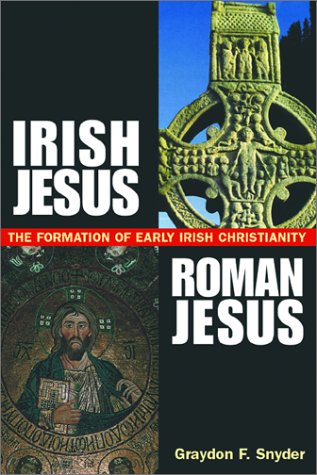
Irish Jesus, Roman Jesus : the formation of early Irish Christianity / Graydon F. Snyder.
Material type: TextPublication details: Harrisburg, Pa. : Trinity Press International, c2002.Description: vii, 280 p. : ill. ; 23 cmISBN:
 - 1563383853 (pbk.)
- 274.15 21
- BR737.C4 S69 2002
| Item type | Current library | Call number | Status | Date due | Barcode |
|---|---|---|---|---|---|
 Books
Books
|
Biblijski institut - Amruševa | 274.15SNYir (Browse shelf(Opens below)) | Available | 528277 |
Browsing Biblijski institut - Amruševa shelves Close shelf browser (Hides shelf browser)
| No cover image available |

|

|

|
No cover image available |

|
No cover image available | ||
| 273BLAma Marcion and his influence / | 273BROhe Heresies : | 274.01KREor The origins of Christendom in the West / | 274.15SNYir Irish Jesus, Roman Jesus : the formation of early Irish Christianity / | 274.206CLEen England's earliest Protestants, 1520-1535 / | 274.2BARen The English church, 1000-1066 : | 274.2BEDhi A history of the English Church and people / |
Includes bibliographical references (p. 261-270) and indexes.
The Celts --
Paul and the Galatians --
Intimations of culture in the Jesus tradition --
The Jesus tradition in Paul's teaching --
Paul and Spain --
The Celts in Spain --
The insular Celts --
Early Christians in Ireland --
Early Christian art and architecture --
The Hebrew scriptures in sculptured art --
The New Testament in sculptured art --
The calendar and Irish Christian language --
Hagiography --
Gender and sexuality --
Commensality --
Theology --
Appendix : The Jesus tradition utilized by Paul.
Nearly two thousand years before the Roman Empire, a group of Celts wandered into the Mediterranean basin, establishing a home in the region of Galatia, modern-day Turkey. They brought with them their political and economic systems, their cultural practices, and their religious traditions. Paul of Tarsus visited Galatia and established churches there. But after his visit, troubling news reached him. Despite Paul's teaching, the Galatian churches were arguing over the correct practice of the Jesus tradition. Paul made a second visit, followed by his letter to the Galatians. In his Irish Jesus, Roman Jesus, Graydon Snyder looks to Galatia for the origins of Irish Christianity, and points to the possibility of a very different course for Christian history. He shows how the religious practices and beliefs of the Galatians--more properly called the Celts--did not fit Paul's teaching and interpretation of the Jesus tradition. The Celts eventually moved to Ireland. The Christianity that they developed there, promulgated by Patrick and others, sharply contrasted with Paul's version that is at the roots of Western orthodox Christianity. If the Celts rather than the Romans had won the day, contemporary Christianity would look very different indeed.
There are no comments on this title.